Linear taper
3D FDTD and EME of a 0.5 → 3 µm linear taper, PSFDTD against Meep and psmeme
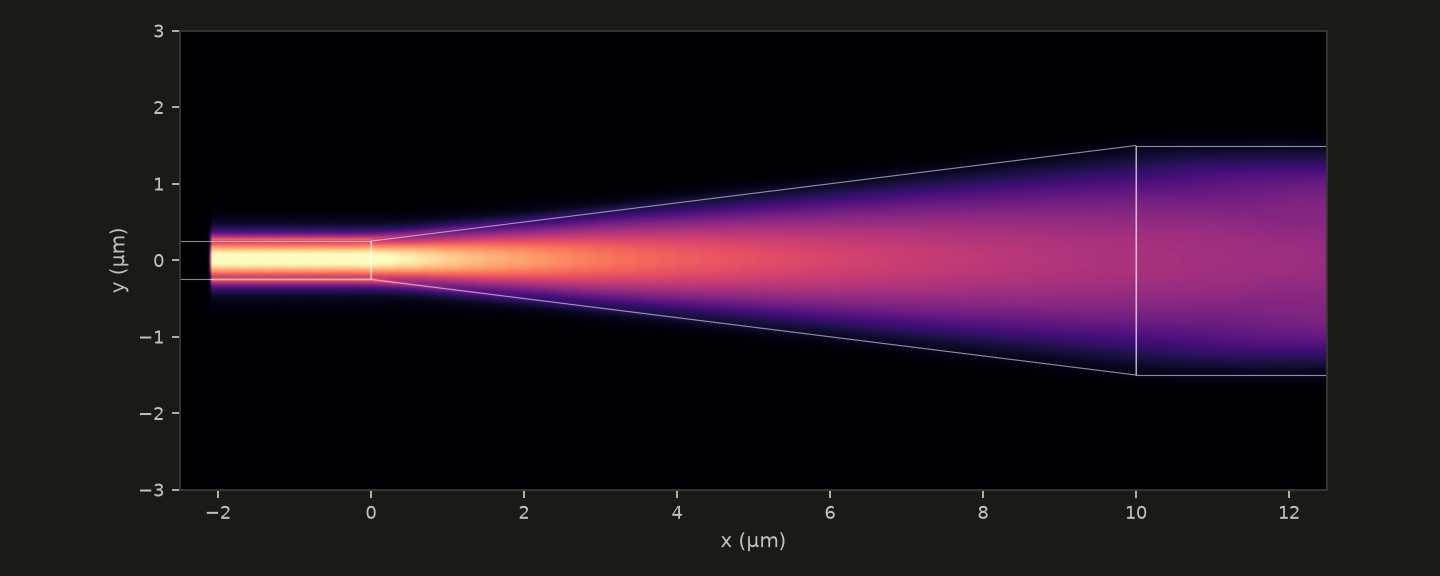
A linear width taper from the 0.5 µm single-mode strip to a 3 µm multimode guide. Short tapers scatter TE0 into higher-order modes of the wide guide; the question is how long it has to be, which is a natural EME problem and an easy 3D FDTD one.
Setup
220 nm silicon strip (n = 3.476) fully clad in SiO₂ (n = 1.444), both non-dispersive, 500 nm wide access guides, TE0 launched by a mode source, 1500–1600 nm from one Gaussian-pulse run. Both solvers read the same polygon list and port planes from bench/devices.py, use a uniform grid of the same step with sub-pixel smoothing, and report TE0 mode-overlap power at each output divided by the forward TE0 power at a monitor just after the source.
Domain 15 × 6 × 2 µm plus PML (PSFDTD: 16 layers; Meep: 1 µm).
Spectrum
Grid convergence
At 25 cells per µm (40 nm), the finest grid both solvers ran, at 1550 nm T(out) = 0.9729 (PSFDTD) against 0.9729 (Meep), largest difference over 1500–1600 nm 0.0004. Refining PSFDTD from there to 80 cells per µm moves the 1550 nm value by at most 0.0002, so at that grid the two solvers differ by less than the remaining discretisation error of either.
Data table
| Series | Grid resolution (cells per µm) | T(out) at 1550 nm |
|---|---|---|
| PSFDTD | 20 | 0.97372 |
| PSFDTD | 25 | 0.97289 |
| PSFDTD | 32 | 0.97334 |
| PSFDTD | 40 | 0.97314 |
| PSFDTD | 50 | 0.9729 |
| PSFDTD | 64 | 0.97308 |
| PSFDTD | 80 | 0.97307 |
| Meep | 20 | 0.97452 |
| Meep | 25 | 0.97294 |
| Cells per µm | Cell (nm) | PSFDTD out | Meep out | Δ |
|---|---|---|---|---|
| 20 | 50 | 0.9737 | 0.9745 | -0.0008 |
| 25 | 40 | 0.9729 | 0.9729 | -0.0000 |
| 32 | 31.25 | 0.9733 | – | – |
| 40 | 25 | 0.9731 | – | – |
| 50 | 20 | 0.9729 | – | – |
| 64 | 15.625 | 0.9731 | – | – |
| 80 | 12.5 | 0.9731 | – | – |
Length sweep, FDTD and EME
TE0-to-TE0 transmission of the linear taper against its length. The EME uses a 160-step staircase on a 300 × 111 cross-section grid with 12 modes per section. At the lengths both methods computed, T differs by at most 0.0295.
Data table
| Series | Taper length (µm) | TE0 loss at 1550 nm (dB) |
|---|---|---|
| PSFDTD 3D, 40 cells/µm | 2 | 2.3958 |
| PSFDTD 3D, 40 cells/µm | 5 | 0.46945 |
| PSFDTD 3D, 40 cells/µm | 10 | 0.11827 |
| PSFDTD 3D, 40 cells/µm | 20 | 0.031814 |
| psmeme EME | 1 | 3.3704 |
| psmeme EME | 1.5 | 3.087 |
| psmeme EME | 2 | 2.6241 |
| psmeme EME | 3 | 1.3744 |
| psmeme EME | 4 | 0.6003 |
| psmeme EME | 5 | 0.44238 |
| psmeme EME | 7.5 | 0.24485 |
| psmeme EME | 10 | 0.15197 |
| psmeme EME | 15 | 0.08942 |
| psmeme EME | 20 | 0.068338 |
| psmeme EME | 30 | 0.052042 |
| psmeme EME | 40 | 0.045251 |
| L (µm) | PSFDTD T (TE0) | PSFDTD loss (dB) | EME T (TE0) |
|---|---|---|---|
| 2 | 0.5760 | 2.396 | 0.5465 |
| 5 | 0.8975 | 0.469 | 0.9032 |
| 10 | 0.9731 | 0.118 | 0.9656 |
| 20 | 0.9927 | 0.032 | 0.9844 |
Runtime
| Solver | Cells per µm | Grid | Stepped cells (M) | Steps | Time stepping | Mcells·steps/s |
|---|---|---|---|---|---|---|
| PSFDTD | 20 | 332×152×72 | 3.63 | 4000 | 2.3 s | 6306 |
| PSFDTD | 25 | 407×182×82 | 6.07 | 4600 | 3.9 s | 7161 |
| PSFDTD | 32 | 512×224×96 | 11.01 | 4800 | 6.8 s | 7768 |
| PSFDTD | 40 | 632×272×112 | 19.25 | 7600 | 18.7 s | 7833 |
| PSFDTD | 50 | 782×332×132 | 34.27 | 6800 | 29.4 s | 7916 |
| PSFDTD | 64 | 992×416×160 | 66.03 | 8600 | 64.0 s | 8874 |
| PSFDTD | 80 | 1232×512×192 | 121.11 | 10600 | 170 s | 7540 |
| Meep | 20 | 340×160×80 | 2.31 | 6004 | 24.9 min ⁎ | 9 ⁎ |
| Meep | 25 | 425×200×100 | 4.45 | 7505 | 16.0 min ⁎ | 35 ⁎ |
PSFDTD: NVIDIA RTX 4090 (single precision); its grid column includes the PML cells. Meep 1.33.0: one core of an AMD Ryzen 9 9950X under WSL2 (the conda build has no MPI), double precision; in 3D it uses the z mirror plane, so it steps half the grid shown. Times are time stepping only, without mesh generation, mode solving or post-processing. The Meep runs themselves shared the machine with other jobs, so their wall times are not used: each Meep time is the stepping rate of that case measured alone on an idle machine (300 steps, all monitors active) multiplied by the run's step count. Rows marked ⁎ have no idle-machine rate and show the contended wall time, which overstates Meep's cost.
Reproduce
# device specs
python bench/devices.py bench/work/specs
# PSFDTD (Windows, GPU): device, cells per µm
python bench/run_psfdtd.py bench/work/specs/taper_l10.json 40 bench/work/psfdtd/taper_l10_res40 --field
# Meep (WSL, micromamba env with pymeep)
bash bench/meep.sh taper_l10 25